Products
Highlights
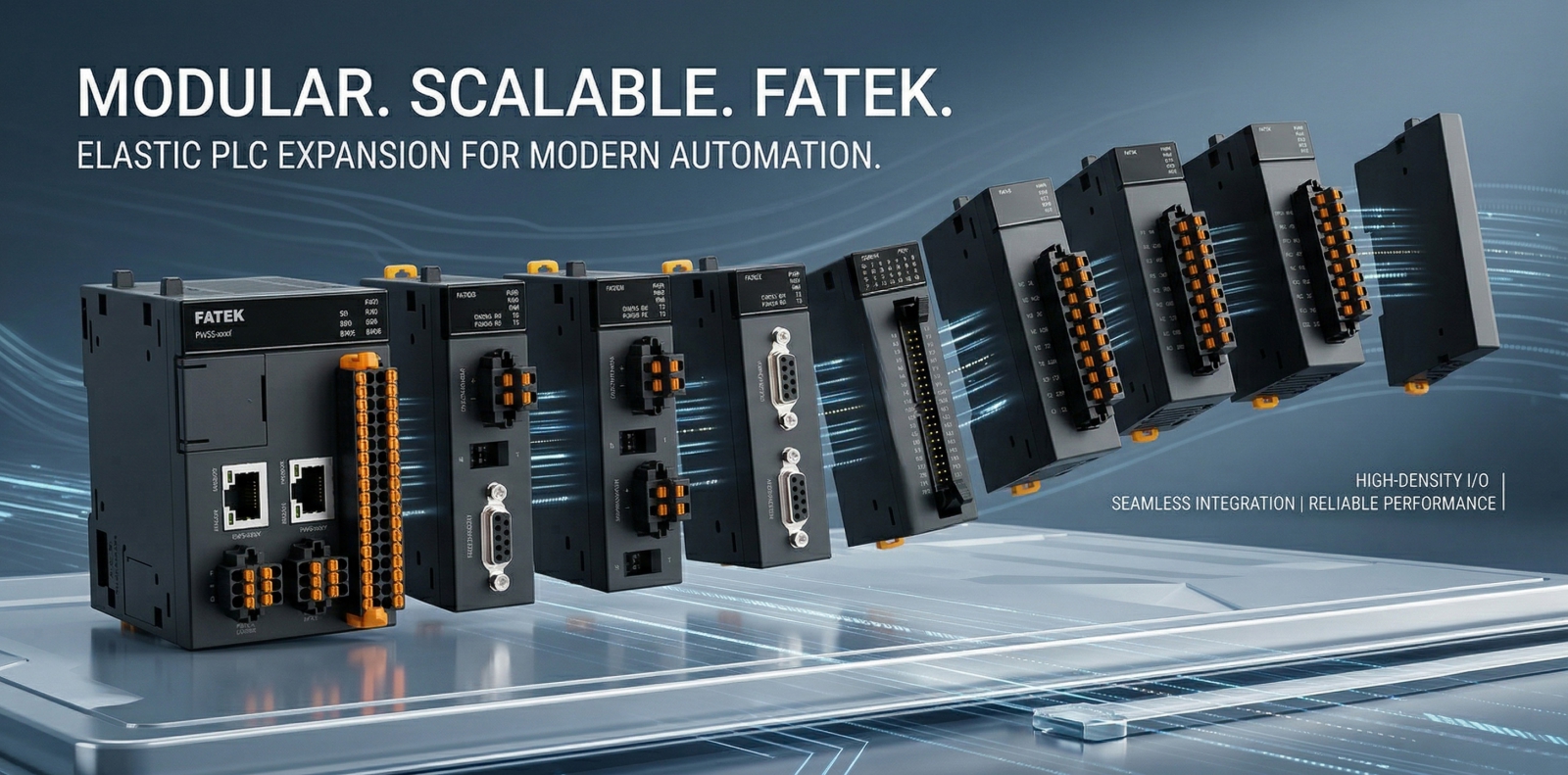
Flexible Expansion: The FATEK MPLC Elastic Expansion Solution
FATEK MPLC
A Flexible Solution for Limitless Expansion
Breaking physical limitations, empowering control systems with infinite expansion potential
In industrial automation scenarios, the flexibility of a control system often determines the upgrade potential and maintenance costs of a production line. With its unique flexible expansion architecture, FATEK MPLC provides users with diverse choices, from basic logic to complex IoT applications.
Whether seeking functional enhancements in compact spaces or building complex expansion networks in large-scale systems, MPLC provides precise hardware support.
Comprehensive Library
1. Comprehensive Module Library
The flexibility of MPLC is primarily reflected in its extensive variety of expansion modules, ensuring customers can make "on-demand" configurations based on project requirements:
Distributed Computing
2. Distributed In-Module Computing: Releasing CPU Core Pressure
This is the essence of MPLC's flexible architecture. Unlike traditional PLCs where all computing pressure is concentrated on the main unit, MPLC's expansion modules possess intelligent in-module computing capabilities:
Specific modules support independent data pre-processing and logical computation without occupying the main CPU's resources.
Through "edge computing" at the module level, the bandwidth pressure of data round-trip transmission and the host processing load are significantly reduced, ensuring the system maintains ultimate, lightning-fast command response even under complex tasks.
Topological Flexibility
3. Topological Flexibility: Breaking the Limits of Physical Layout
To adapt to various complex control cabinet spaces, MPLC supports highly free physical connection methods, taking "flexibility" to the extreme:
MQ Series Plug-in
4. MQ Series: The Ultimate Space Efficiency Solution
For application scenarios with limited installation space, the MPLC MQ series introduces an innovative Plug-in expansion method:
Conclusion
5. Advantage Summary: Why Choose MPLC's Flexible Architecture?
在工業自動化場景中,控制系統的靈活性往往決定了產線的升級潛力與維護成本。FATEK MPLC 憑藉其獨特的彈性擴充架構,為用戶提供了從基礎邏輯到複雜物聯網應用的多元化選擇。無論是在精簡的空間內尋求功能增強,還是在大型系統中構建複雜的擴充網絡,MPLC 都能提供精準的硬體支持。.png)
全能模組庫
MPLC 的彈性首先體現在其極為豐富的擴充模組種類上,確保客戶可以根據專案需求進行「點餐式」配置:
基礎訊號處理:
支持多種點數的 DIO(數位量輸入/輸出) 與 AIO(類比量輸入/輸出) 模組。
高精度專用模型:
針對特定複雜演算法提供高精度專用擴充模型,滿足精細化控制需求。
垂直行業方案:
支持荷重(稱重)模組,直接處理感測器訊號,簡化系統架構。
工業互聯:
配備 IoT(物聯網)模組與多樣化的通訊模組,輕鬆實現設備上雲與跨平台交互。
分散式內運算:釋放 CPU 核心壓力
這是 MPLC 彈性架構的精髓所在。不同於傳統 PLC 所有運算壓力均集中於主機的模式,MPLC 的擴充模組具備智慧內運算能力:
負載分流:
特定模組支持獨立進行資料預處理與邏輯運算,無需佔用主機 CPU 資源。
提升響應效率:
透過模組端的「邊緣運算」,大幅降低了資料往返傳輸的頻寬壓力與主機處理負荷,確保系統在複雜任務下依然能保持極致的極速指令響應。
拓撲靈活性
為了適應各種複雜的控制櫃空間,MPLC 支持高度自由的物理連接方式,將「彈性」發揮到極致:
超大規模擴充: 系統目前最高可支持 64 個模組,滿足從中型到超大型自動化系統的容量需求。
分支擴充技術: 模組支持靈活的分支擴充,無論是整齊的單排擴充、空間高效利用的多排擴充,還是邏輯複雜的混合擴充,MPLC 均能完美支持。
自適應佈局:用戶可以根據機櫃的深度與寬度,自由規劃模組的排列走向,極大降低了佈線難度與空間壓力。
MQ 系列:極致的空間效率方案
針對安裝空間受限的應用場景,MPLC MQ 系列引入了創新的 Plug-in(插件式) 擴充方式:
零佔用擴充:
無需在導軌上額外增加擴充空間,即可直接在主機上擴充 Plug-in 模組。
主機性能增強:
透過直接在主機面板上插入功能插件,在保持系統高度整合化的同時,瞬間獲得所需的特殊功能。
優勢總結:為什麼選擇 MPLC 的彈性架構?
高度靈活性: 從模組種類到排列方式,給予客戶完全的定義權。
高效能運行: 模組內運算技術讓系統整體效率翻倍,降低 CPU 負載。
低集成成本:支持 64 個模組的上限,意味著一套系統即可搞定過去需要多套控制器才能完成的任務。
